Centuries-old roots in the Grand Duchy.
A family at the heart of Luxembourg
They began as ironmasters. Two families of the Meuse valley — the Bidarts of Dinant, who came first in 1624, and the Marchants of Bouvignes, documented in their town since 1431, who followed three years later. They were not knights. The name Marchant comes from marchau, the master smith. They arrived in the Duchy of Luxembourg to buy forges, and the two lines joined in 1652 by marriage.
What they did next was unusual. The lords of Ansembourg, the Ravilles, had borrowed heavily against their land; as the debts went unpaid, the iron money bought them out — field by field, wood by wood, village by village. By 1671 the seigneurie had changed hands, and by 1711 it was whole again under a single owner. Ansembourg was won not by arms or by court favour, but by capital and patience: one cancelled debt at a time.
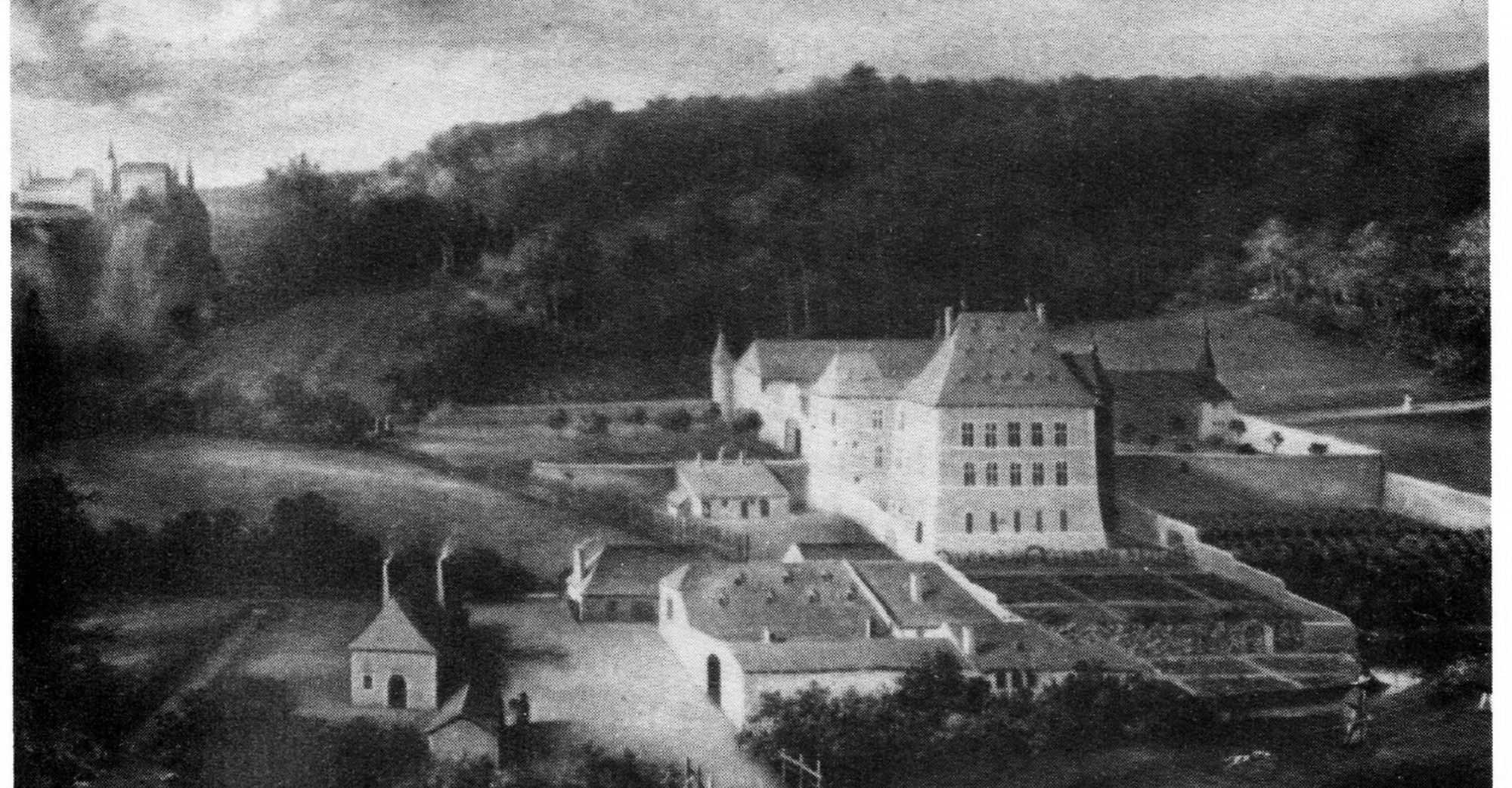
Within a century the family held seigneurial rights over some twenty villages of the Duchy, from the Eisch valley to the Moselle, and a string of castles across the west of the country — of which they built two themselves: the Grand Château d'Ansembourg, raised in the valley below the old fortress, and Dommeldange, built beside its forges.
The titles followed. Baron d'Ansembourg in 1728, from Charles VI. Comte d'Ansembourg in 1749, from Maria Theresa — granted not as Empress in Vienna but in her capacity as sovereign of Luxembourg, in respect of a Luxembourg seigneurie. In 1750, Francis I added the countship of the Holy Roman Empire on top. The first two are Luxembourg titles in the strictest sense: given here, for here.
Two paintings, eighty years apart


A family in pictures
Stones, faces, gardens, gatherings — a few images from the family's archive. (More will be added over time.)


Six centuries · at a glance
Where the family has lived
Every castle, forge and seat the family has held — across Luxembourg, Liège, Dutch Limburg and Westphalia. Click any marker to read its story.
A quiet claim
Many noble families once held land in what is now the Grand Duchy. When Luxembourg separated from Belgium in 1839, most of those families — seated in Arlon, Bastogne, Marche or further west — passed to Belgian nationality with the territory. The d'Ansembourgs, seated at Ansembourg in the canton of Mersch, remained.
Nothing has replaced those grants since. The Grand Duke retains the right to confer nobility, but unlike his Belgian cousin he does not exercise it: no Luxembourg family has been ennobled in modern times. The single later creation in the Luxembourg nobility was the countship of Wisborg, granted by Grand Duke Adolphe in 1892 to a Swedish prince who had forfeited his own titles by marrying without the King's consent — a foreign house, not a Luxembourg one.
So the barony of 1728 and the countship of 1749 stand, as far as the record shows, as the last hereditary titles created in Luxembourg for a family of the country — granted by Luxembourg's own sovereigns, in respect of a Luxembourg seigneurie.
The titles pass by blood, not with the land. The 1749 diploma makes the countship transmissible by male primogeniture, the 1750 grant carries to every descendant, and neither is conditional on holding the seigneurie. Estates have been bought, inherited, divided and sold across three centuries, as in any family over that span; the name and the titles have carried on regardless. Of the titled houses of the old Duchy, the d'Ansembourgs are the one that stayed.
The fact is worth naming, not to rank one family above another, but because it is part of the country's history; a family that does not name its own continuity makes it easier for everyone to forget.
The four grants are documented — see the history for the diplomas themselves.
Father and son
On 14 January 1891, Grand-Duke Adolphe named Comte Amaury (1849–1926) Chargé d'Affaires of Luxembourg in Brussels. He had served as a diplomat at Berlin and Lisbon, and was chamberlain to both the Grand Duchess and the King of the Netherlands. He was also, for forty-five years, mayor of Tuntange — the Grand Duchy is a country where a man may represent his sovereign abroad and still run his own village.
His son Comte Gaston (1891–1957) entered the same legation as secretary at twenty-three, and was made Conseiller de Légation in 1922. Through the First World War father and son both remained at their posts in occupied Brussels, while the family sheltered at Ansembourg. Gaston worked alongside the Marquis de Villalobar on the Commission for Relief of Belgium, feeding a starving population, and afterwards helped shape the Belgo-Luxembourg Economic Union of 1921 — the treaty that tied the two countries' economies together for the century that followed.
A fortress of the fourteenth century… there is a ghost… an extraordinary glow… I thought of Hamlet's words to Horatio. Victor Hugo, on visiting the ruined Old Castle of Ansembourg, 1871
The family chronicle
For decades the family has kept its own internal yearbook, the Cahiers d'Ansembourg — a handsome, large-format chronicle of births, weddings, anniversaries, articles, photographs and memoirs. Twenty-four issues are gathered in the family's private area, where they can be read and searched.
Family members may request the password from the editor — see Contact.